Ci dessous un pseudo tuto pour mes confrères qui comme moi découvre l'arduino.
Votre sonde a base de dht11, dht22 ds18b20 seras reconnu comme un sonde Oregon.
L'article du Pro:
-dht11 + attiny85 (script oregon) + rf433 => http://labalec.fr/erwan/?p=1534
-DS18B20 + attiny85 (script oregon) +rf433 =>http://labalec.fr/erwan/?p=1520
Commande:
A prendre une fois:
-UNO R3 MEGA328P ATMEGA16U2 for Arduino Compatible env 7$ sur aliexpress
A prendre pour une sonde:
-Attiny 85 env 1,15$
-Sonde pas chère env 1,5$
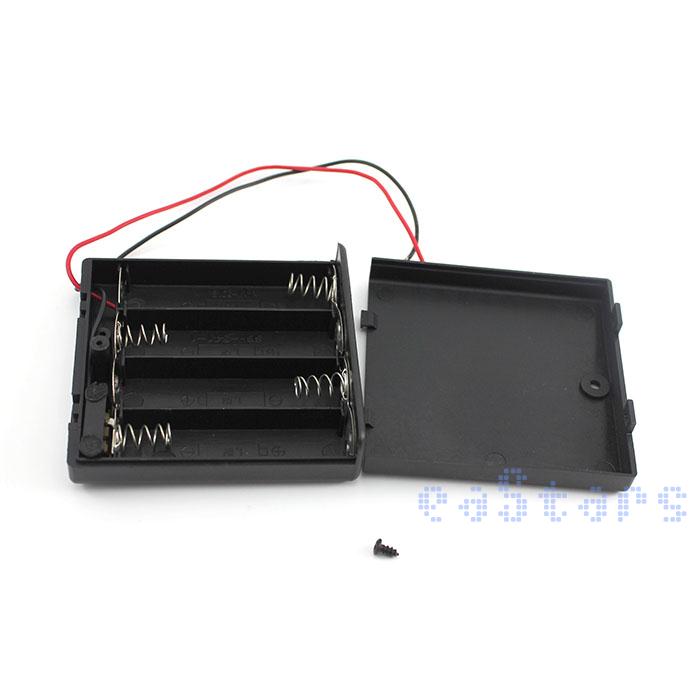
-Un support pile 1.28$ (qui prendra je l'espère 3 piles et le circuit)
La base:
1-Télécharger et installer le logiciel Arduino
http://arduino.cc/download.php?f=/ardui ... indows.exe
2-Brancher l'arduino
3-Vérifier dans le gestionnaire de périphérique que l'arduino est bien reconnu
=>Si non reconnu installer le driver et allez pointer sur le dossier fraichement installé dans le dossier driver (c:program files/arduino/drivers)
=>Vous pouvez en profiter pour regarder le port com de l'arduino (dans Ports(com et LPT))
4-Débrancher / redemarrer
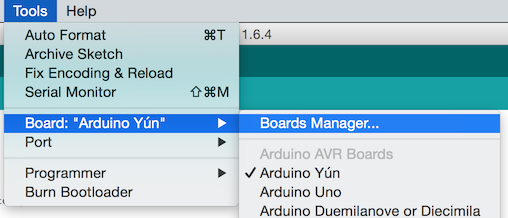
5-Pour que la carte Arduino Uno soit capable de programmer un Attiny il faut le lui dire.
- Branchez la carte Arduino Uno au port USB de votre ordinateur
- Lancer le programme Arduino
- Allez dans ( outils/port série) sélectionnez le port COM sur le quel est connecté la carte Arduino.
- Allez dans ( Fichier/exemple) et cliquez sur ( ArduinoISP )
- Dans la nouvelle fenetre allez dans ( Outils/Type de carte) cliquez sur ( Arduino Uno )
- Allez dans ( Fichier ) cliquez sur Téléverser
=>Téléversement terminé
- Fermer les deux fenetres
__________________________________________________________________________________________
DTH11
1-Copier le script http://labalec.fr/erwan/wp-content/uplo ... _dht11.txt
Code : Tout sélectionner
/*
 * connectingStuff, Oregon Scientific v2.1 Emitter
 * http://connectingstuff.net/blog/encodage-protocoles-oregon-scientific-sur-arduino/
 *
 * Copyright (C) 2013 olivier.lebrun@gmail.com
 *
 * This program is free software; you can redistribute it and/or
 * modify it under the terms of the GNU General Public License
 * as published by the Free Software Foundation; either version 2
 * of the License, or (at your option) any later version.
 *
 * This program is distributed in the hope that it will be useful,
 * but WITHOUT ANY WARRANTY; without even the implied warranty of
 * MERCHANTABILITY or FITNESS FOR A PARTICULAR PURPOSE.  See the
 * GNU General Public License for more details.
 *
 * You should have received a copy of the GNU General Public License
 * along with this program; if not, write to the Free Software
 * Foundation, Inc., 51 Franklin Street, Fifth Floor, Boston, MA  02110-1301, USA.
*/


#include <avr/sleep.h>
#include <avr/wdt.h>

#ifndef cbi
#define cbi(sfr, bit) (_SFR_BYTE(sfr) &= ~_BV(bit))
#endif
#ifndef sbi
#define sbi(sfr, bit) (_SFR_BYTE(sfr) |= _BV(bit))
#endif

volatile boolean f_wdt = 1;

#include <dht11.h>
#define DHT11PIN PB1
dht11 DHT11;


#include <SoftwareSerial.h>
#define SERIAL_RX PB3 //pin 2 //INPUT
#define SERIAL_TX PB4 //pin 3 //OUTPUT
SoftwareSerial TinySerial(SERIAL_RX, SERIAL_TX); // RX, TX


//#define THN132N

const byte TX_PIN = 0;


const unsigned long TIME = 512;
const unsigned long TWOTIME = TIME*2;

#define SEND_HIGH() digitalWrite(TX_PIN, HIGH)
#define SEND_LOW() digitalWrite(TX_PIN, LOW)

// Buffer for Oregon message
#ifdef THN132N
  byte OregonMessageBuffer[8];
#else
  byte OregonMessageBuffer[9];
#endif

/**
 * \brief    Send logical "0" over RF
 * \details  azero bit be represented by an off-to-on transition
 * \         of the RF signal at the middle of a clock period.
 * \         Remenber, the Oregon v2.1 protocol add an inverted bit first
 */
inline void sendZero(void)
{
  SEND_HIGH();
  delayMicroseconds(TIME);
  SEND_LOW();
  delayMicroseconds(TWOTIME);
  SEND_HIGH();
  delayMicroseconds(TIME);
}

/**
 * \brief    Send logical "1" over RF
 * \details  a one bit be represented by an on-to-off transition
 * \         of the RF signal at the middle of a clock period.
 * \         Remenber, the Oregon v2.1 protocol add an inverted bit first
 */
inline void sendOne(void)
{
   SEND_LOW();
   delayMicroseconds(TIME);
   SEND_HIGH();
   delayMicroseconds(TWOTIME);
   SEND_LOW();
   delayMicroseconds(TIME);
}

/**
* Send a bits quarter (4 bits = MSB from 8 bits value) over RF
*
* @param data Source data to process and sent
*/

/**
 * \brief    Send a bits quarter (4 bits = MSB from 8 bits value) over RF
 * \param    data   Data to send
 */
inline void sendQuarterMSB(const byte data)
{
  (bitRead(data, 4)) ? sendOne() : sendZero();
  (bitRead(data, 5)) ? sendOne() : sendZero();
  (bitRead(data, 6)) ? sendOne() : sendZero();
  (bitRead(data, 7)) ? sendOne() : sendZero();
}

/**
 * \brief    Send a bits quarter (4 bits = LSB from 8 bits value) over RF
 * \param    data   Data to send
 */
inline void sendQuarterLSB(const byte data)
{
  (bitRead(data, 0)) ? sendOne() : sendZero();
  (bitRead(data, 1)) ? sendOne() : sendZero();
  (bitRead(data, 2)) ? sendOne() : sendZero();
  (bitRead(data, 3)) ? sendOne() : sendZero();
}

/******************************************************************/
/******************************************************************/
/******************************************************************/

/**
 * \brief    Send a buffer over RF
 * \param    data   Data to send
 * \param    size   size of data to send
 */
void sendData(byte *data, byte size)
{
  for(byte i = 0; i < size; ++i)
  {
    sendQuarterLSB(data[i]);
    sendQuarterMSB(data[i]);
  }
}

/**
 * \brief    Send an Oregon message
 * \param    data   The Oregon message
 */
void sendOregon(byte *data, byte size)
{
    sendPreamble();
    //sendSync();
    sendData(data, size);
    sendPostamble();
}

/**
 * \brief    Send preamble
 * \details  The preamble consists of 16 "1" bits
 */
inline void sendPreamble(void)
{
  byte PREAMBLE[]={0xFF,0xFF};
  sendData(PREAMBLE, 2);
}

/**
 * \brief    Send postamble
 * \details  The postamble consists of 8 "0" bits
 */
inline void sendPostamble(void)
{
#ifdef THN132N
  sendQuarterLSB(0x00);
#else
  byte POSTAMBLE[]={0x00};
  sendData(POSTAMBLE, 1);
#endif
}

/**
 * \brief    Send sync nibble
 * \details  The sync is 0xA. It is not use in this version since the sync nibble
 * \         is include in the Oregon message to send.
 */
inline void sendSync(void)
{
  sendQuarterLSB(0xA);
}

/******************************************************************/
/******************************************************************/
/******************************************************************/

/**
 * \brief    Set the sensor type
 * \param    data       Oregon message
 * \param    type       Sensor type
 */
inline void setType(byte *data, byte* type)
{
  data[0] = type[0];
  data[1] = type[1];
}

/**
 * \brief    Set the sensor channel
 * \param    data       Oregon message
 * \param    channel    Sensor channel (0x10, 0x20, 0x30)
 */
inline void setChannel(byte *data, byte channel)
{
    data[2] = channel;
}

/**
 * \brief    Set the sensor ID
 * \param    data       Oregon message
 * \param    ID         Sensor unique ID
 */
inline void setId(byte *data, byte ID)
{
  data[3] = ID;
}

/**
 * \brief    Set the sensor battery level
 * \param    data       Oregon message
 * \param    level      Battery level (0 = low, 1 = high)
 */
void setBatteryLevel(byte *data, byte level)
{
  if(!level) data[4] = 0x0C;
  else data[4] = 0x00;
}

/**
 * \brief    Set the sensor temperature
 * \param    data       Oregon message
 * \param    temp       the temperature
 */
void setTemperature(byte *data, float temp)
{
  // Set temperature sign
  if(temp < 0)
  {
    data[6] = 0x08;
    temp *= -1;
  }
  else
  {
    data[6] = 0x00;
  }

  // Determine decimal and float part
  int tempInt = (int)temp;
  int td = (int)(tempInt / 10);
  int tf = (int)round((float)((float)tempInt/10 - (float)td) * 10);

  int tempFloat =  (int)round((float)(temp - (float)tempInt) * 10);

  // Set temperature decimal part
  data[5] = (td << 4);
  data[5] |= tf;

  // Set temperature float part
  data[4] |= (tempFloat << 4);
}

/**
 * \brief    Set the sensor humidity
 * \param    data       Oregon message
 * \param    hum        the humidity
 */
void setHumidity(byte* data, byte hum)
{
    data[7] = (hum/10);
    data[6] |= (hum - data[7]*10) << 4;
}

/**
 * \brief    Sum data for checksum
 * \param    count      number of bit to sum
 * \param    data       Oregon message
 */
int Sum(byte count, const byte* data)
{
  int s = 0;

  for(byte i = 0; i<count;i++)
  {
    s += (data[i]&0xF0) >> 4;
    s += (data[i]&0xF);
  }

  if(int(count) != count)
    s += (data[count]&0xF0) >> 4;

  return s;
}

/**
 * \brief    Calculate checksum
 * \param    data       Oregon message
 */
void calculateAndSetChecksum(byte* data)
{
#ifdef THN132N
    int s = ((Sum(6, data) + (data[6]&0xF) - 0xa) & 0xff);

    data[6] |=  (s&0x0F) << 4;     data[7] =  (s&0xF0) >> 4;
#else
    data[8] = ((Sum(8, data) - 0xa) & 0xFF);
#endif
}


/******************************************************************/

void setup()
{
  setup_watchdog(9);
  //pinMode(PB3, OUTPUT);
  //digitalWrite(PB3,HIGH);delay(500);
  //digitalWrite(PB3,LOW);delay(500);
  //digitalWrite(PB3,HIGH);
  pinMode(TX_PIN, OUTPUT);


 pinMode(PB4, OUTPUT); //tx
  TinySerial.begin(9600);
  TinySerial.println("\n[Oregon V2.1 encoder]");

  SEND_LOW();


#ifdef THN132N
  // Create the Oregon message for a temperature only sensor (TNHN132N)
  byte ID[] = {0xEA,0x4C};
#else
  // Create the Oregon message for a temperature/humidity sensor (THGR2228N)
  byte ID[] = {0x1A,0x2D};
#endif

  setType(OregonMessageBuffer, ID);
  setChannel(OregonMessageBuffer, 0x20);
  setId(OregonMessageBuffer, 0xEE);
}


// set system into the sleep state
// system wakes up when wtchdog is timed out
void system_sleep() {
  cbi(ADCSRA,ADEN);                    // switch Analog to Digitalconverter OFF

  set_sleep_mode(SLEEP_MODE_PWR_DOWN); // sleep mode is set here
  sleep_enable();

  sleep_mode();                        // System sleeps here

  sleep_disable();                     // System continues execution here when watchdog timed out
  sbi(ADCSRA,ADEN);                    // switch Analog to Digitalconverter ON
}

// 0=16ms, 1=32ms,2=64ms,3=128ms,4=250ms,5=500ms
// 6=1 sec,7=2 sec, 8=4 sec, 9= 8sec
void setup_watchdog(int ii) {

  byte bb;
  int ww;
  if (ii > 9 ) ii=9;
  bb=ii & 7;
  if (ii > 7) bb|= (1<<5);
  bb|= (1<<WDCE);
  ww=bb;

  MCUSR &= ~(1<<WDRF);
  // start timed sequence
  WDTCR |= (1<<WDCE) | (1<<WDE);
  // set new watchdog timeout value
  WDTCR = bb;
  WDTCR |= _BV(WDIE);
}

// Watchdog Interrupt Service / is executed when watchdog timed out
ISR(WDT_vect) {
  f_wdt=1;  // set global flag
}


void loop()
{
  int chk = DHT11.read(DHT11PIN);

   switch (chk)
  {
    case DHTLIB_OK:
      TinySerial.println("OK");
      break;
    case DHTLIB_ERROR_CHECKSUM:
      TinySerial.println("Checksum error");
      break;
    case DHTLIB_ERROR_TIMEOUT:
      TinySerial.println("Time out error");
      break;
    default:
      TinySerial.println("Unknown error");
      break;
  }

  TinySerial.print("Temperature : ");TinySerial.print(DHT11.temperature);TinySerial.write(176); // caractère °
  TinySerial.write('C'); TinySerial.println();
  TinySerial.print("Humidity : ");TinySerial.print(DHT11.humidity);
  TinySerial.write('%'); TinySerial.println();

  // (ie: 1wire DS18B20 for température, ...)
  setBatteryLevel(OregonMessageBuffer, 0); // 0 : low, 1 : high
  setTemperature(OregonMessageBuffer, DHT11.temperature);

#ifndef THN132N
  // Set Humidity
  setHumidity(OregonMessageBuffer, DHT11.humidity);
#endif

  // Calculate the checksum
  calculateAndSetChecksum(OregonMessageBuffer);

  // Show the Oregon Message
  for (byte i = 0; i < sizeof(OregonMessageBuffer); ++i)   {
    //TinySerial.print(OregonMessageBuffer[i] >> 4, HEX);
    //TinySerial.print(OregonMessageBuffer[i] & 0x0F, HEX);
  }

  // Send the Message over RF
  sendOregon(OregonMessageBuffer, sizeof(OregonMessageBuffer));
  // Send a "pause"
  SEND_LOW();
  delayMicroseconds(TWOTIME*8);
  // Send a copie of the first message. The v2.1 protocol send the
  // message two time
  sendOregon(OregonMessageBuffer, sizeof(OregonMessageBuffer));

  // Wait for 30 seconds before send a new message
  SEND_LOW();
  //

  //9 secs * 6 = 54 secs
  system_sleep();
  system_sleep();
  system_sleep();
  system_sleep();
  system_sleep();
  system_sleep();
  //
  //delay(30000);

}
3-faire un fichier enregistrer sous mes documents/arduino/rf433_sendOOK_at85_dht11.ino
4-Dans mes documents/arduino/libraries cree un dossier dht11
5-Dans dht11 cree 2 fichier txt dht11h.txt et un dht11cpp.txt
6-Dans dht11h.txt coller le script du meme nom trouvé ici http://playground.arduino.cc/Main/DHT11Lib ou ci dessous puis enregistrer et le renommer en dht11.h
Code : Tout sélectionner
//
//    FILE: dht11.h
// VERSION: 0.4.1
// PURPOSE: DHT11 Temperature & Humidity Sensor library for Arduino
// LICENSE: GPL v3 (http://www.gnu.org/licenses/gpl.html)
//
// DATASHEET: http://www.micro4you.com/files/sensor/DHT11.pdf
//
//     URL: http://playground.arduino.cc/Main/DHT11Lib
//
// HISTORY:
// George Hadjikyriacou - Original version
// see dht.cpp file
//

#ifndef dht11_h
#define dht11_h

#if defined(ARDUINO) && (ARDUINO >= 100)
#include <Arduino.h>
#else
#include <WProgram.h>
#endif

#define DHT11LIB_VERSION "0.4.1"

#define DHTLIB_OK				0
#define DHTLIB_ERROR_CHECKSUM	-1
#define DHTLIB_ERROR_TIMEOUT	-2

class dht11
{
public:
    int read(int pin);
	int humidity;
	int temperature;
};
#endif
//
// END OF FILE
//
8-Meme chose pour le cpp
Code : Tout sélectionner
//
//    FILE: dht11.cpp
// VERSION: 0.4.1
// PURPOSE: DHT11 Temperature & Humidity Sensor library for Arduino
// LICENSE: GPL v3 (http://www.gnu.org/licenses/gpl.html)
//
// DATASHEET: http://www.micro4you.com/files/sensor/DHT11.pdf
//
// HISTORY:
// George Hadjikyriacou - Original version (??)
// Mod by SimKard - Version 0.2 (24/11/2010)
// Mod by Rob Tillaart - Version 0.3 (28/03/2011)
// + added comments
// + removed all non DHT11 specific code
// + added references
// Mod by Rob Tillaart - Version 0.4 (17/03/2012)
// + added 1.0 support
// Mod by Rob Tillaart - Version 0.4.1 (19/05/2012)
// + added error codes
//

#include "dht11.h"

// Return values:
// DHTLIB_OK
// DHTLIB_ERROR_CHECKSUM
// DHTLIB_ERROR_TIMEOUT
int dht11::read(int pin)
{
	// BUFFER TO RECEIVE
	uint8_t bits[5];
	uint8_t cnt = 7;
	uint8_t idx = 0;

	// EMPTY BUFFER
	for (int i=0; i< 5; i++) bits[i] = 0;

	// REQUEST SAMPLE
	pinMode(pin, OUTPUT);
	digitalWrite(pin, LOW);
	delay(18);
	digitalWrite(pin, HIGH);
	delayMicroseconds(40);
	pinMode(pin, INPUT);

	// ACKNOWLEDGE or TIMEOUT
	unsigned int loopCnt = 10000;
	while(digitalRead(pin) == LOW)
		if (loopCnt-- == 0) return DHTLIB_ERROR_TIMEOUT;

	loopCnt = 10000;
	while(digitalRead(pin) == HIGH)
		if (loopCnt-- == 0) return DHTLIB_ERROR_TIMEOUT;

	// READ OUTPUT - 40 BITS => 5 BYTES or TIMEOUT
	for (int i=0; i<40; i++)
	{
		loopCnt = 10000;
		while(digitalRead(pin) == LOW)
			if (loopCnt-- == 0) return DHTLIB_ERROR_TIMEOUT;

		unsigned long t = micros();

		loopCnt = 10000;
		while(digitalRead(pin) == HIGH)
			if (loopCnt-- == 0) return DHTLIB_ERROR_TIMEOUT;

		if ((micros() - t) > 40) bits[idx] |= (1 << cnt);
		if (cnt == 0)   // next byte?
		{
			cnt = 7;    // restart at MSB
			idx++;      // next byte!
		}
		else cnt--;
	}

	// WRITE TO RIGHT VARS
        // as bits[1] and bits[3] are allways zero they are omitted in formulas.
	humidity    = bits[0];
	temperature = bits[2];

	uint8_t sum = bits[0] + bits[2];

	if (bits[4] != sum) return DHTLIB_ERROR_CHECKSUM;
	return DHTLIB_OK;
}
//
// END OF FILE
//
10-Pour que ca fonctionne j'ai eu besoin de télécharger et d'installer tiny8x pcrel patch.zip récupéréhttp://forum.arduino.cc/index.php?topic=116674.0 ou en direct http://forum.arduino.cc/index.php?actio ... tach=22984
(pour l'installation il suiffit de coller le fichier a la fin de l'arborescence (vérifier que la date de modification est bien changer))
Message d'erreur si non installé:
Code : Tout sélectionner
This report would have more information with
  "Show verbose output during compilation"
  enabled in File > Preferences.
Arduino: 1.0.6 (Windows XP), Board: "ATtiny85 (internal 8 MHz clock)"
c:/program files/arduino/hardware/tools/avr/bin/../lib/gcc/avr/4.3.2/../../../../avr/lib/avr25/crttn85.o:(.init9+0x2): relocation truncated to fit: R_AVR_13_PCREL against symbol `exit' defined in .fini9 section in c:/program files/arduino/hardware/tools/avr/bin/../lib/gcc/avr/4.3.2/avr25\libgcc.a(_exit.o)
rf433_sendOOK_at85_dht11.cpp.o: In function `setHumidity(unsigned char*, unsigned char)':
C:\Program Files\Arduino/rf433_sendOOK_at85_dht11.ino:277: relocation truncated to fit: R_AVR_13_PCREL against symbol `__udivmodqi4' defined in .text.libgcc section in c:/program files/arduino/hardware/tools/avr/bin/../lib/gcc/avr/4.3.2/avr25\libgcc.a(_udivmodqi4.o)
C:\Program Files\Arduino/rf433_sendOOK_at85_dht11.ino:278: relocation truncated to fit: R_AVR_13_PCREL against symbol `__mulhi3' defined in .text.libgcc section in c:/program files/arduino/hardware/tools/avr/bin/../lib/gcc/avr/4.3.2/avr25\libgcc.a(_mulhi3.o)
rf433_sendOOK_at85_dht11.cpp.o: In function `setTemperature(unsigned char*, float)':
C:\Program Files\Arduino/rf433_sendOOK_at85_dht11.ino:256: relocation truncated to fit: R_AVR_13_PCREL against symbol `__fixsfsi' defined in .text.fplib section in c:/program files/arduino/hardware/tools/avr/bin/../lib/gcc/avr/4.3.2/../../../../avr/lib/avr25\libm.a(fixsfsi.o)
C:\Program Files\Arduino/rf433_sendOOK_at85_dht11.ino:257: relocation truncated to fit: R_AVR_13_PCREL against symbol `__divmodhi4' defined in .text.libgcc section in c:/program files/arduino/hardware/tools/avr/bin/../lib/gcc/avr/4.3.2/avr25\libgcc.a(_divmodhi4.o)
C:\Program Files\Arduino/rf433_sendOOK_at85_dht11.ino:258: relocation truncated to fit: R_AVR_13_PCREL against symbol `__floatsisf' defined in .text.fplib section in c:/program files/arduino/hardware/tools/avr/bin/../lib/gcc/avr/4.3.2/../../../../avr/lib/avr25\libm.a(floatsisf.o)
C:\Program Files\Arduino/rf433_sendOOK_at85_dht11.ino:258: relocation truncated to fit: R_AVR_13_PCREL against symbol `__floatsisf' defined in .text.fplib section in c:/program files/arduino/hardware/tools/avr/bin/../lib/gcc/avr/4.3.2/../../../../avr/lib/avr25\libm.a(floatsisf.o)
C:\Program Files\Arduino/rf433_sendOOK_at85_dht11.ino:258: relocation truncated to fit: R_AVR_13_PCREL against symbol `__mulsf3' defined in .text.fplib section in c:/program files/arduino/hardware/tools/avr/bin/../lib/gcc/avr/4.3.2/../../../../avr/lib/avr25\libm.a(mulsf3.o)
C:\Program Files\Arduino/rf433_sendOOK_at85_dht11.ino:258: relocation truncated to fit: R_AVR_13_PCREL against symbol `round' defined in .text.fplib section in c:/program files/arduino/hardware/tools/avr/bin/../lib/gcc/avr/4.3.2/../../../../avr/lib/avr25\libm.a(round.o)
C:\Program Files\Arduino/rf433_sendOOK_at85_dht11.ino:260: relocation truncated to fit: R_AVR_13_PCREL against symbol `__mulsf3' defined in .text.fplib section in c:/program files/arduino/hardware/tools/avr/bin/../lib/gcc/avr/4.3.2/../../../../avr/lib/avr25\libm.a(mulsf3.o)
C:\Program Files\Arduino/rf433_sendOOK_at85_dht11.ino:260: additional relocation overflows omitted from the output-télécharger le fichier de paramétrage de l'attiny http://labalec.fr/erwan/wp-content/uplo ... attiny.zip et l'installer dans Documents\Arduino\hardware (soit au final Documents\Arduino\hardware\attiny\variants...)
-et la mettre dans Documents\Arduino\ (il y aura donc dans arduino 5 dossiers + 4 fichiers)
-Démarrer le soft Arduino
-faire fichier/exemples/arduinoisp
-Ouvrir votre script "rf433_sendOOK_at85_dht11.ino"
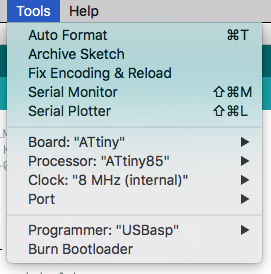
- dans outils/programmateur faire « arduino as isp »
- dans outils\type de carte choisir « attiny85 (8mhz) »
-Faire compiler
-Puis outils/graver la séquence d'initialisation
-Apparation d'un pseudo message d'erreur
-Puis téléverser.
-Apparation d'un pseudo message d'erreur
-Fermer
-Réaliser le branchement qui va bien http://labalec.fr/erwan/?p=1534
-enjoy
__________________________________________________________________________
DTH22
1-Copier le script de traveled
Code : Tout sélectionner
/*
 * connectingStuff, Oregon Scientific v2.1 Emitter
 * http://connectingstuff.net/blog/encodage-protocoles-oregon-scientific-sur-arduino/
 *
 * Copyright (C) 2013 olivier.lebrun@gmail.com
 *
 * This program is free software; you can redistribute it and/or
 * modify it under the terms of the GNU General Public License
 * as published by the Free Software Foundation; either version 2
 * of the License, or (at your option) any later version.
 *
 * This program is distributed in the hope that it will be useful,
 * but WITHOUT ANY WARRANTY; without even the implied warranty of
 * MERCHANTABILITY or FITNESS FOR A PARTICULAR PURPOSE.  See the
 * GNU General Public License for more details.
 *
 * You should have received a copy of the GNU General Public License
 * along with this program; if not, write to the Free Software
 * Foundation, Inc., 51 Franklin Street, Fifth Floor, Boston, MA  02110-1301, USA.
*/

#include <avr/sleep.h>
#include <avr/wdt.h>

#ifndef cbi
#define cbi(sfr, bit) (_SFR_BYTE(sfr) &= ~_BV(bit))
#endif
#ifndef sbi
#define sbi(sfr, bit) (_SFR_BYTE(sfr) |= _BV(bit))
#endif

volatile boolean f_wdt = 1;

#include <dht.h>
dht DHT;
#define DHT22_PIN 1

//#include <SoftwareSerial.h>
//#define SERIAL_RX PB3 //pin 2 //INPUT
//#define SERIAL_TX PB4 //pin 3 //OUTPUT
//SoftwareSerial TinySerial(SERIAL_RX, SERIAL_TX); // RX, TX


const byte TX_PIN = 0;


const unsigned long TIME = 512;
const unsigned long TWOTIME = TIME*2;

#define SEND_HIGH() digitalWrite(TX_PIN, HIGH)
#define SEND_LOW() digitalWrite(TX_PIN, LOW)

// Buffer for Oregon message
  byte OregonMessageBuffer[9];

/**
 * \brief    Send logical "0" over RF
 * \details  azero bit be represented by an off-to-on transition
 * \         of the RF signal at the middle of a clock period.
 * \         Remenber, the Oregon v2.1 protocol add an inverted bit first
 */
inline void sendZero(void)
{
  SEND_HIGH();
  delayMicroseconds(TIME);
  SEND_LOW();
  delayMicroseconds(TWOTIME);
  SEND_HIGH();
  delayMicroseconds(TIME);
}

/**
 * \brief    Send logical "1" over RF
 * \details  a one bit be represented by an on-to-off transition
 * \         of the RF signal at the middle of a clock period.
 * \         Remenber, the Oregon v2.1 protocol add an inverted bit first
 */
inline void sendOne(void)
{
   SEND_LOW();
   delayMicroseconds(TIME);
   SEND_HIGH();
   delayMicroseconds(TWOTIME);
   SEND_LOW();
   delayMicroseconds(TIME);
}

/**
* Send a bits quarter (4 bits = MSB from 8 bits value) over RF
*
* @param data Source data to process and sent
*/

/**
 * \brief    Send a bits quarter (4 bits = MSB from 8 bits value) over RF
 * \param    data   Data to send
 */
inline void sendQuarterMSB(const byte data)
{
  (bitRead(data, 4)) ? sendOne() : sendZero();
  (bitRead(data, 5)) ? sendOne() : sendZero();
  (bitRead(data, 6)) ? sendOne() : sendZero();
  (bitRead(data, 7)) ? sendOne() : sendZero();
}

/**
 * \brief    Send a bits quarter (4 bits = LSB from 8 bits value) over RF
 * \param    data   Data to send
 */
inline void sendQuarterLSB(const byte data)
{
  (bitRead(data, 0)) ? sendOne() : sendZero();
  (bitRead(data, 1)) ? sendOne() : sendZero();
  (bitRead(data, 2)) ? sendOne() : sendZero();
  (bitRead(data, 3)) ? sendOne() : sendZero();
}

/******************************************************************/
/******************************************************************/
/******************************************************************/

/**
 * \brief    Send a buffer over RF
 * \param    data   Data to send
 * \param    size   size of data to send
 */
void sendData(byte *data, byte size)
{
  for(byte i = 0; i < size; ++i)
  {
    sendQuarterLSB(data[i]);
    sendQuarterMSB(data[i]);
  }
}

/**
 * \brief    Send an Oregon message
 * \param    data   The Oregon message
 */
void sendOregon(byte *data, byte size)
{
    sendPreamble();
    //sendSync();
    sendData(data, size);
    sendPostamble();
}

/**
 * \brief    Send preamble
 * \details  The preamble consists of 16 "1" bits
 */
inline void sendPreamble(void)
{
  byte PREAMBLE[]={0xFF,0xFF};
  sendData(PREAMBLE, 2);
}

/**
 * \brief    Send postamble
 * \details  The postamble consists of 8 "0" bits
 */
inline void sendPostamble(void)
{
  byte POSTAMBLE[]={0x00};
  sendData(POSTAMBLE, 1);
}

/**
 * \brief    Send sync nibble
 * \details  The sync is 0xA. It is not use in this version since the sync nibble
 * \         is include in the Oregon message to send.
 */
inline void sendSync(void)
{
  sendQuarterLSB(0xA);
}

/******************************************************************/
/******************************************************************/
/******************************************************************/

/**
 * \brief    Set the sensor type
 * \param    data       Oregon message
 * \param    type       Sensor type
 */
inline void setType(byte *data, byte* type)
{
  data[0] = type[0];
  data[1] = type[1];
}

/**
 * \brief    Set the sensor channel
 * \param    data       Oregon message
 * \param    channel    Sensor channel (0x10, 0x20, 0x30)
 */
inline void setChannel(byte *data, byte channel)
{
    data[2] = channel;
}

/**
 * \brief    Set the sensor ID
 * \param    data       Oregon message
 * \param    ID         Sensor unique ID
 */
inline void setId(byte *data, byte ID)
{
  data[3] = ID;
}

/**
 * \brief    Set the sensor battery level
 * \param    data       Oregon message
 * \param    level      Battery level (0 = low, 1 = high)
 */
void setBatteryLevel(byte *data, byte level)
{
  if(!level) data[4] = 0x0C;
  else data[4] = 0x00;
}

/**
 * \brief    Set the sensor temperature
 * \param    data       Oregon message
 * \param    temp       the temperature
 */
void setTemperature(byte *data, float temp)
{
  // Set temperature sign
  if(temp < 0)
  {
    data[6] = 0x08;
    temp *= -1;
  }
  else
  {
    data[6] = 0x00;
  }

  // Determine decimal and float part
  int tempInt = (int)temp;
  int td = (int)(tempInt / 10);
  int tf = (int)round((float)((float)tempInt/10 - (float)td) * 10);

  int tempFloat =  (int)round((float)(temp - (float)tempInt) * 10);

  // Set temperature decimal part
  data[5] = (td << 4);
  data[5] |= tf;

  // Set temperature float part
  data[4] |= (tempFloat << 4);
}

/**
 * \brief    Set the sensor humidity
 * \param    data       Oregon message
 * \param    hum        the humidity
 */
void setHumidity(byte* data, byte hum)
{
    data[7] = (hum/10);
    data[6] |= (hum - data[7]*10) << 4;
}

/**
 * \brief    Sum data for checksum
 * \param    count      number of bit to sum
 * \param    data       Oregon message
 */
int Sum(byte count, const byte* data)
{
  int s = 0;

  for(byte i = 0; i<count;i++)
  {
    s += (data[i]&0xF0) >> 4;
    s += (data[i]&0xF);
  }

  if(int(count) != count)
    s += (data[count]&0xF0) >> 4;

  return s;
}

/**
 * \brief    Calculate checksum
 * \param    data       Oregon message
 */
void calculateAndSetChecksum(byte* data)
{

    data[8] = ((Sum(8, data) - 0xa) & 0xFF);

}


/******************************************************************/

void setup()
{
  setup_watchdog(9);
  //pinMode(PB3, OUTPUT);
  //digitalWrite(PB3,HIGH);delay(500);
  //digitalWrite(PB3,LOW);delay(500);
  //digitalWrite(PB3,HIGH);
  //pinMode(TX_PIN, OUTPUT);


//  pinMode(PB4, OUTPUT); //tx
//  TinySerial.begin(9600);
//  TinySerial.println("\n[Oregon V2.1 encoder]");

  SEND_LOW();

  // Create the Oregon message for a temperature/humidity sensor (THGR2228N)
  byte ID[] = {0x1A,0x2D};

  setType(OregonMessageBuffer, ID);
  setChannel(OregonMessageBuffer, 0x20);
  setId(OregonMessageBuffer, 0xBB);
}


// set system into the sleep state
// system wakes up when wtchdog is timed out
void system_sleep() {
  cbi(ADCSRA,ADEN);                    // switch Analog to Digitalconverter OFF

  set_sleep_mode(SLEEP_MODE_PWR_DOWN); // sleep mode is set here
  sleep_enable();

  sleep_mode();                        // System sleeps here

  sleep_disable();                     // System continues execution here when watchdog timed out
  sbi(ADCSRA,ADEN);                    // switch Analog to Digitalconverter ON
}

// 0=16ms, 1=32ms,2=64ms,3=128ms,4=250ms,5=500ms
// 6=1 sec,7=2 sec, 8=4 sec, 9= 8sec
void setup_watchdog(int ii) {

  byte bb;
  int ww;
  if (ii > 9 ) ii=9;
  bb=ii & 7;
  if (ii > 7) bb|= (1<<5);
  bb|= (1<<WDCE);
  ww=bb;

  MCUSR &= ~(1<<WDRF);
  // start timed sequence
  WDTCR |= (1<<WDCE) | (1<<WDE);
  // set new watchdog timeout value
  WDTCR = bb;
  WDTCR |= _BV(WDIE);
}

// Watchdog Interrupt Service / is executed when watchdog timed out
ISR(WDT_vect) {
  f_wdt=1;  // set global flag
}


void loop()
{
  int chk = DHT.read22(DHT22_PIN);

  setBatteryLevel(OregonMessageBuffer, 1); // 0 : low, 1 : high
  setTemperature(OregonMessageBuffer, DHT.temperature);

  setHumidity(OregonMessageBuffer, DHT.humidity);

  // Calculate the checksum
  calculateAndSetChecksum(OregonMessageBuffer);

  // Show the Oregon Message
  for (byte i = 0; i < sizeof(OregonMessageBuffer); ++i)   {
  }
   // Send the Message over RF
  sendOregon(OregonMessageBuffer, sizeof(OregonMessageBuffer));
  // Send a "pause"
  SEND_LOW();
  delayMicroseconds(TWOTIME*8);
  // Send a copie of the first message. The v2.1 protocol send the
  // message two time
  sendOregon(OregonMessageBuffer, sizeof(OregonMessageBuffer));
  SEND_LOW();
  //
  //9 secs * 6 = 54 secs
  system_sleep();
  system_sleep();
  system_sleep();
  system_sleep();
  system_sleep();
  system_sleep();
  //
  //delay(30000);

}
3-faire un fichier enregistrer sous mes documents/arduino/rf433_sendOOK_at85_dht22.ino
4-Dans mes documents/arduino/libraries cree un dossier dht
5-Dans dht cree 2 fichier txt dhth.txt et un dhtcpp.txt
6-Dans dhth.txt coller le script du meme nom trouvé ici http://playground.arduino.cc/Main/DHTLib ou ci dessous puis enregistrer et le renommer en dht.h
Code : Tout sélectionner
//
//    FILE: dht.h
//  AUTHOR: Rob Tillaart
// VERSION: 0.1.14
// PURPOSE: DHT Temperature & Humidity Sensor library for Arduino
//     URL: http://arduino.cc/playground/Main/DHTLib
//
// HISTORY:
// see dht.cpp file
//

#ifndef dht_h
#define dht_h

#if ARDUINO < 100
#include <WProgram.h>
#else
#include <Arduino.h>
#endif

#define DHT_LIB_VERSION "0.1.14"

#define DHTLIB_OK                0
#define DHTLIB_ERROR_CHECKSUM   -1
#define DHTLIB_ERROR_TIMEOUT    -2
#define DHTLIB_INVALID_VALUE    -999

#define DHTLIB_DHT11_WAKEUP     18
#define DHTLIB_DHT_WAKEUP       1

// max timeout is 100 usec.
// For a 16 Mhz proc 100 usec is 1600 clock cycles
// loops using DHTLIB_TIMEOUT use at least 4 clock cycli
// so 100 us takes max 400 loops
// so by dividing F_CPU by 40000 we "fail" as fast as possible
#define DHTLIB_TIMEOUT (F_CPU/40000)

class dht
{
public:
    // return values:
    // DHTLIB_OK
    // DHTLIB_ERROR_CHECKSUM
    // DHTLIB_ERROR_TIMEOUT
    int read11(uint8_t pin);
    int read(uint8_t pin);

    inline int read21(uint8_t pin) { return read(pin); };
    inline int read22(uint8_t pin) { return read(pin); };
    inline int read33(uint8_t pin) { return read(pin); };
    inline int read44(uint8_t pin) { return read(pin); };

    double humidity;
    double temperature;

private:
    uint8_t bits[5];  // buffer to receive data
    int _readSensor(uint8_t pin, uint8_t wakeupDelay);
};
#endif
//
// END OF FILE
//
Code : Tout sélectionner
//
//    FILE: dht.cpp
//  AUTHOR: Rob Tillaart
// VERSION: 0.1.14
// PURPOSE: DHT Temperature & Humidity Sensor library for Arduino
//     URL: http://arduino.cc/playground/Main/DHTLib
//
// HISTORY:
// 0.1.14 replace digital read with faster (~3x) code => more robust low MHz machines.
// 0.1.13 fix negative temperature
// 0.1.12 support DHT33 and DHT44 initial version
// 0.1.11 renamed DHTLIB_TIMEOUT
// 0.1.10 optimized faster WAKEUP + TIMEOUT
// 0.1.09 optimize size: timeout check + use of mask
// 0.1.08 added formula for timeout based upon clockspeed
// 0.1.07 added support for DHT21
// 0.1.06 minimize footprint (2012-12-27)
// 0.1.05 fixed negative temperature bug (thanks to Roseman)
// 0.1.04 improved readability of code using DHTLIB_OK in code
// 0.1.03 added error values for temp and humidity when read failed
// 0.1.02 added error codes
// 0.1.01 added support for Arduino 1.0, fixed typos (31/12/2011)
// 0.1.00 by Rob Tillaart (01/04/2011)
//
// inspired by DHT11 library
//
// Released to the public domain
//

#include "dht.h"

/////////////////////////////////////////////////////
//
// PUBLIC
//

// return values:
// DHTLIB_OK
// DHTLIB_ERROR_CHECKSUM
// DHTLIB_ERROR_TIMEOUT
int dht::read11(uint8_t pin)
{
    // READ VALUES
    int rv = _readSensor(pin, DHTLIB_DHT11_WAKEUP);
    if (rv != DHTLIB_OK)
    {
        humidity    = DHTLIB_INVALID_VALUE; // invalid value, or is NaN prefered?
        temperature = DHTLIB_INVALID_VALUE; // invalid value
        return rv;
    }

    // CONVERT AND STORE
    humidity    = bits[0];  // bits[1] == 0;
    temperature = bits[2];  // bits[3] == 0;

    // TEST CHECKSUM
    // bits[1] && bits[3] both 0
    uint8_t sum = bits[0] + bits[2];
    if (bits[4] != sum) return DHTLIB_ERROR_CHECKSUM;

    return DHTLIB_OK;
}


// return values:
// DHTLIB_OK
// DHTLIB_ERROR_CHECKSUM
// DHTLIB_ERROR_TIMEOUT
int dht::read(uint8_t pin)
{
    // READ VALUES
    int rv = _readSensor(pin, DHTLIB_DHT_WAKEUP);
    if (rv != DHTLIB_OK)
    {
        humidity    = DHTLIB_INVALID_VALUE;  // invalid value, or is NaN prefered?
        temperature = DHTLIB_INVALID_VALUE;  // invalid value
        return rv; // propagate error value
    }

    // CONVERT AND STORE
    humidity = word(bits[0], bits[1]) * 0.1;
    temperature = word(bits[2] & 0x7F, bits[3]) * 0.1;
    if (bits[2] & 0x80)  // negative temperature
    {
        temperature = -temperature;
    }

    // TEST CHECKSUM
    uint8_t sum = bits[0] + bits[1] + bits[2] + bits[3];
    if (bits[4] != sum)
    {
        return DHTLIB_ERROR_CHECKSUM;
    }
    return DHTLIB_OK;
}

/////////////////////////////////////////////////////
//
// PRIVATE
//

// return values:
// DHTLIB_OK
// DHTLIB_ERROR_TIMEOUT
int dht::_readSensor(uint8_t pin, uint8_t wakeupDelay)
{
    // INIT BUFFERVAR TO RECEIVE DATA
    uint8_t mask = 128;
    uint8_t idx = 0;

    // replace digitalRead() with Direct Port Reads.
    // reduces footprint ~100 bytes => portability issue?
    // direct port read is about 3x faster
	uint8_t bit = digitalPinToBitMask(pin);
	uint8_t port = digitalPinToPort(pin);
    volatile uint8_t *PIR = portInputRegister(port);

    // EMPTY BUFFER
    for (uint8_t i = 0; i < 5; i++) bits[i] = 0;

    // REQUEST SAMPLE
    pinMode(pin, OUTPUT);
    digitalWrite(pin, LOW); // T-be
    delay(wakeupDelay);
    digitalWrite(pin, HIGH);   // T-go
    delayMicroseconds(40);
    pinMode(pin, INPUT);

    // GET ACKNOWLEDGE or TIMEOUT
    uint16_t loopCntLOW = DHTLIB_TIMEOUT;
    while ((*PIR & bit) == LOW )  // T-rel
    {
        if (--loopCntLOW == 0) return DHTLIB_ERROR_TIMEOUT;
    }

    uint16_t loopCntHIGH = DHTLIB_TIMEOUT;
    while ((*PIR & bit) != LOW )  // T-reh
    {
        if (--loopCntHIGH == 0) return DHTLIB_ERROR_TIMEOUT;
    }

    // READ THE OUTPUT - 40 BITS => 5 BYTES
    for (uint8_t i = 40; i != 0; i--)
    {
        loopCntLOW = DHTLIB_TIMEOUT;
        while ((*PIR & bit) == LOW )
        {
            if (--loopCntLOW == 0) return DHTLIB_ERROR_TIMEOUT;
        }

        uint32_t t = micros();

        loopCntHIGH = DHTLIB_TIMEOUT;
        while ((*PIR & bit) != LOW )
        {
            if (--loopCntHIGH == 0) return DHTLIB_ERROR_TIMEOUT;
        }

        if ((micros() - t) > 40)
        {
            bits[idx] |= mask;
        }
        mask >>= 1;
        if (mask == 0)   // next byte?
        {
            mask = 128;
            idx++;
        }
    }
    pinMode(pin, OUTPUT);
    digitalWrite(pin, HIGH);

    return DHTLIB_OK;
}
//
// END OF FILE
//
10-Pour que ca fonctionne j'ai eu besoin de télécharger et d'installer tiny8x pcrel patch.zip récupéréhttp://forum.arduino.cc/index.php?topic=116674.0 ou en direct http://forum.arduino.cc/index.php?actio ... tach=22984
(pour l'installation il suiffit de coller le fichier a la fin de l'arborescence (vérifier que la date de modification est bien changer))
Message d'erreur si non installé:
Code : Tout sélectionner
This report would have more information with
  "Show verbose output during compilation"
  enabled in File > Preferences.
Arduino: 1.0.6 (Windows XP), Board: "ATtiny85 (internal 8 MHz clock)"
c:/program files/arduino/hardware/tools/avr/bin/../lib/gcc/avr/4.3.2/../../../../avr/lib/avr25/crttn85.o:(.init9+0x2): relocation truncated to fit: R_AVR_13_PCREL against symbol `exit' defined in .fini9 section in c:/program files/arduino/hardware/tools/avr/bin/../lib/gcc/avr/4.3.2/avr25\libgcc.a(_exit.o)
rf433_sendOOK_at85_dht11.cpp.o: In function `setHumidity(unsigned char*, unsigned char)':
C:\Program Files\Arduino/rf433_sendOOK_at85_dht11.ino:277: relocation truncated to fit: R_AVR_13_PCREL against symbol `__udivmodqi4' defined in .text.libgcc section in c:/program files/arduino/hardware/tools/avr/bin/../lib/gcc/avr/4.3.2/avr25\libgcc.a(_udivmodqi4.o)
C:\Program Files\Arduino/rf433_sendOOK_at85_dht11.ino:278: relocation truncated to fit: R_AVR_13_PCREL against symbol `__mulhi3' defined in .text.libgcc section in c:/program files/arduino/hardware/tools/avr/bin/../lib/gcc/avr/4.3.2/avr25\libgcc.a(_mulhi3.o)
rf433_sendOOK_at85_dht11.cpp.o: In function `setTemperature(unsigned char*, float)':
C:\Program Files\Arduino/rf433_sendOOK_at85_dht11.ino:256: relocation truncated to fit: R_AVR_13_PCREL against symbol `__fixsfsi' defined in .text.fplib section in c:/program files/arduino/hardware/tools/avr/bin/../lib/gcc/avr/4.3.2/../../../../avr/lib/avr25\libm.a(fixsfsi.o)
C:\Program Files\Arduino/rf433_sendOOK_at85_dht11.ino:257: relocation truncated to fit: R_AVR_13_PCREL against symbol `__divmodhi4' defined in .text.libgcc section in c:/program files/arduino/hardware/tools/avr/bin/../lib/gcc/avr/4.3.2/avr25\libgcc.a(_divmodhi4.o)
C:\Program Files\Arduino/rf433_sendOOK_at85_dht11.ino:258: relocation truncated to fit: R_AVR_13_PCREL against symbol `__floatsisf' defined in .text.fplib section in c:/program files/arduino/hardware/tools/avr/bin/../lib/gcc/avr/4.3.2/../../../../avr/lib/avr25\libm.a(floatsisf.o)
C:\Program Files\Arduino/rf433_sendOOK_at85_dht11.ino:258: relocation truncated to fit: R_AVR_13_PCREL against symbol `__floatsisf' defined in .text.fplib section in c:/program files/arduino/hardware/tools/avr/bin/../lib/gcc/avr/4.3.2/../../../../avr/lib/avr25\libm.a(floatsisf.o)
C:\Program Files\Arduino/rf433_sendOOK_at85_dht11.ino:258: relocation truncated to fit: R_AVR_13_PCREL against symbol `__mulsf3' defined in .text.fplib section in c:/program files/arduino/hardware/tools/avr/bin/../lib/gcc/avr/4.3.2/../../../../avr/lib/avr25\libm.a(mulsf3.o)
C:\Program Files\Arduino/rf433_sendOOK_at85_dht11.ino:258: relocation truncated to fit: R_AVR_13_PCREL against symbol `round' defined in .text.fplib section in c:/program files/arduino/hardware/tools/avr/bin/../lib/gcc/avr/4.3.2/../../../../avr/lib/avr25\libm.a(round.o)
C:\Program Files\Arduino/rf433_sendOOK_at85_dht11.ino:260: relocation truncated to fit: R_AVR_13_PCREL against symbol `__mulsf3' defined in .text.fplib section in c:/program files/arduino/hardware/tools/avr/bin/../lib/gcc/avr/4.3.2/../../../../avr/lib/avr25\libm.a(mulsf3.o)
C:\Program Files\Arduino/rf433_sendOOK_at85_dht11.ino:260: additional relocation overflows omitted from the output-télécharger le fichier de paramétrage de l'attiny http://labalec.fr/erwan/wp-content/uplo ... attiny.zip et l'installer dans Documents\Arduino\hardware (soit au final Documents\Arduino\hardware\attiny\variants...)
-et la mettre dans Documents\Arduino\ (il y aura donc dans arduino 5 dossiers + 4 fichiers)
-Démarrer le soft Arduino
-faire fichier/exemples/arduinoisp
-Ouvrir votre script "rf433_sendOOK_at85_dht11.ino"
- dans outils/programmateur faire « arduino as isp »
- dans outils\type de carte choisir « attiny85 (8mhz) »
-Faire compiler
-Puis outils/graver la séquence d'initialisation
-Apparation d'un pseudo message d'erreur
-Puis téléverser.
-Apparation d'un pseudo message d'erreur
-Fermer
-Réaliser le branchement qui va bien http://labalec.fr/erwan/?p=1534
-enjoy
__________________________________________________________________________
DS18B20 en dessous