Bonsoir
Voici le retour de mes expérimentations avec mon wemosD1.
J'ai fais bcp de captures pour essayer de bien comprendre le protocole, et surprise j'ai un zero de trop à la fin du premier octet (et donc un décalage de l'ensemble du message). Ainsi au lieu d'avoir un device ID qui commence par 7, le mien commence par 3,
Et lorsque je rejoue les commandes avec le zero supplémentaire, elle fonctionne.
Pour info, j'utilise les codes de @tchuene (en lecture & écriture) que j'ai modifié, j'ai rajouté la gestion du stuffing et bcp de log pour comprendre et le support de SysLog pour dumper les messages sur mon PI.
Voici la version pour lire les trames pour les courageux
Code : Tout sélectionner
// active/desactive les traces SYSLOG
//#define SYSLOG

#ifdef SYSLOG
#include <ESP8266WiFi.h>
#include <WiFiUdp.h>
#include <Syslog.h>

// WIFI credentials
#define WIFI_SSID "********"
#define WIFI_PASS "********"

// Syslog server connection info
#define SYSLOG_SERVER "192.168.0.7"
#define SYSLOG_PORT 514

// This device info
#define DEVICE_HOSTNAME "wemosD1"
#define APP_NAME "my-app"

// A UDP instance to let us send and receive packets over UDP
WiFiUDP udpClient;

// Create a new syslog instance with LOG_KERN facility
Syslog syslog(udpClient, SYSLOG_SERVER, SYSLOG_PORT, DEVICE_HOSTNAME, APP_NAME, LOG_KERN);
#endif

volatile long duration = 0;
volatile long prev_time = 0;
volatile boolean data_dispo = false;
byte input = 4;
String trame[3];
byte  hex[20];
byte message = 0;
byte start = true;
byte intro = 0;
String prefixe = "1100";
int cpt = 1;

char text[50] ;


void setup() {
  Serial.begin(500000);
  Serial.println();
  Serial.println();

  #ifdef SYSLOG
  // We start by connecting to a WiFi network
  Serial.print("Connecting to ");
  Serial.println(WIFI_SSID);
  WiFi.begin(WIFI_SSID, WIFI_PASS);

  while (WiFi.status() != WL_CONNECTED) {
    delay(500);
    Serial.print(".");
  }
  Serial.println("");

  Serial.println("WiFi connected");
  Serial.println("IP address: ");
  Serial.println(WiFi.localIP());

  syslog.logf(LOG_ERR, "START");
  #endif


  attachInterrupt(digitalPinToInterrupt(input), declenche, CHANGE);
  memset(text, 0, 50);
  Serial.println("\nSTART\n");


}

void loop() {
  if (data_dispo == true) {
    int bit_state = digitalRead(input);
    //if (bit_state == HIGH) Serial.printf("-");
    //else Serial.printf("_");

    if ((duration > 700) && (duration < 950)) { // pulse off court
      trame[message] = trame[message] + !bit_state;
    } else if ((duration > 1400) && (duration < 1950)) { // pulse off long
      // verifie qu'on commence avec un pulse long à 1
      if ((start == true) && (!bit_state == HIGH)) {
        trame[message] = trame[message] + !bit_state + !bit_state;
        start = false;
      } else if (start == false) {
        trame[message] = trame[message] + !bit_state + !bit_state;
      }
    } else {
      start = true; // debut d'une nouvelle trame
      if (trame[message].length() > 200) {
        message++;
        if (message > 2) {
          for (message = 0; message < 3; message++) {

            for (int x = 0; x <= 50; x=x+4) {
              if (trame[message].substring(x,x+4).compareTo(prefixe) == 0) {
                intro++;
              } else {
                break;
              }
            }
            String sortie = "";
            if (intro >= 6 ) {

              sortie = "";

              int nbBit = 0;
              int nbOne = 0;

              // décodage des bits de la trame: 00=0, 11=0, 10=1, 01=1
              for (int x = (intro*4); x <= trame[message].length(); x=x+2) {
                if ((trame[message].substring(x,x+2) == "00") or (trame[message].substring(x,x+2) == "11")) {
                  if (!((nbOne == 5) && (nbBit >= 8*7) && (nbBit <8*12)))     // gestion du Stuffing pour les octets entre 7 et 11 inclu
                    sortie = sortie + "0";
                  nbOne = 0;
                } else {
                  sortie = sortie + "1";
                  nbOne ++;
                }
                nbBit++;
              }

              Serial.printf("BIN = ");
              for (int cpt = 0; cpt<sortie.length() ;cpt++) {
                Serial.printf("%c",sortie.substring(cpt,cpt+1)[0]);
                if (cpt % 4 == 3) Serial.printf(" ");
                if (cpt % 8 == 7) Serial.printf(" ");

              }
              Serial.printf("\n");


              // repartition en bytes
              /*
              Serial.printf("IN = ");
              for (int cpt = 0; cpt<trame[message].length() ;cpt++) {
                Serial.printf("%c",trame[message].substring(cpt,cpt+1)[0]);
                if (cpt % 8 == 7) Serial.printf(" ");
              }

              Serial.printf("\nOUT = ");
              for (int cpt = 0; cpt<sortie.length() ;cpt++) {
                Serial.printf("%c",sortie.substring(cpt,cpt+1)[0]);
                if (cpt % 8 == 7) Serial.printf(" ");
              }
              Serial.printf("\n");
              */


              memset(hex,0,20);

              strcpy(text,"");
              Serial.printf("\nHEX = ");
              for (int cpt=0; cpt<sortie.length(); cpt+=8) {
                hex[cpt / 8] = convert(sortie.substring(cpt,cpt+8));
                sprintf(text,"%s%02X",text,hex[cpt / 8]);
                if ((cpt % 32) == 24) Serial.printf(" ");

                if ((cpt % 32) == 24) sprintf(text,"%s ",text);
                Serial.printf("%02X",hex[cpt / 8]);

              }
              Serial.printf("\n");


              /* RAPPEL (src https://antoinegrall.wordpress.com/decodage-frisquet-ers/)
                Octet 00 – 11111101 = 0xBF – Fixe, attitré à chaque chaudière
                Octet 01 – 01100111 = 0xE6 – Fixe, attitré à chaque chaudière
                Octet 02 – 11001111 = 0xF3 – Fixe, attitré à chaque chaudière
                Octet 03 – 00000000 = 0x00 – Fixe
                Octet 04 – 00000100 = 0x20 – Fixe
                Octet 05 – 00000000 = 0x00 – Fixe
                Octet 06 – 00000000 = 0x00 – Fixe
                Octet 07 – 11000001 = 0x83 – Variable, préchauffage eau
                Octet 08 – 10101010 = 0x55 – Variable, chauffage
                Octet 09 – 00000000 = 0x00 – Niveau pile ?
                Octet 10 – 10111111 = 0xFD – Fixe
                Octet 11 – 00100010 = 0x44 – Variable checksum
                Octet 12 – 11111111 = 0xFF – Fixe, fin du message
                Octet 13 – 00000000 = 0x00 – Fixe
               */


              bool err = 0;

              // ID de ma frisquet devrait etre fixe
              if (!((hex[0] == 0x3F) && (hex[1] == 0xE4) && (hex[2] == 0x0A))) {
                err += 1;
                Serial.printf("ID  error : %02X %02X %02X\n",hex[0],hex[1],hex[2]);

                #ifdef SYSLOG
                syslog.logf(LOG_INFO, "ID  error : %02X %02X %02X",hex[0],hex[1],hex[2]);
                #endif
              }
              // Devrait etre fixe, mais bon ...
              if (!((hex[3] == 0x00) && (hex[4] == 0x10) && ((hex[5] == 0x00) || (hex[5] == 0x80)))) {
                err += 2;
                Serial.printf("FIX error : %02X %02X %02X\n",hex[3],hex[4],hex[5]);

                #ifdef SYSLOG
                syslog.logf(LOG_INFO, "FIX error : %02X %02X %02X",hex[3],hex[4],hex[5]);
                #endif
              }

             // Trame corromptue ?
             if ((hex[8] == 0xFF) && (hex[9] == 0xFF)) {
                err += 4;
                Serial.printf("FF  error : %02X %02X %02X\n",hex[8],hex[9],hex[10]);

                #ifdef SYSLOG
                syslog.logf(LOG_INFO, "FIX error : %02X %02X %02X",hex[8],hex[9],hex[10]);
                #endif
              }

              Serial.printf("VALUE %d   NUM %02X  COMMAND %02X   HEATING %3d  ERROR %d\n",message, hex[6],hex[7],hex[8],err);

              #ifdef SYSLOG
              syslog.logf(LOG_INFO, "VALUE=%d; NUM=%02X; COMMAND=%02X; HEATING=%03d ;ERROR=%d; HEX=%s",message, hex[6],hex[7],hex[8],err,text);
              #endif

              intro = 0;

            }
            else {    // pas de synchro
              Serial.printf("SKIP [%d] = ", intro);

              for (int cpt = 0; cpt<8*8;cpt++) {
                Serial.printf("%c",trame[message].substring(cpt,cpt+1)[0]);
                if ((cpt % 4) == 3) Serial.printf(" ");
              }

              #ifdef SYSLOG
              syslog.logf(LOG_INFO, "SKIP [%d]", intro);
              #endif

              Serial.printf("\n");
            }

            Serial.println("----");
          }

          trame[0] = "";
          trame[1] = "";
          trame[2] = "";
          Serial.println();
          message = 0;
        }
      } else {
        trame[0] = "";
        trame[1] = "";
        trame[2] = "";
        message = 0;
      }
    }
    data_dispo = false;
  }
}

void declenche() {
  duration = micros()-prev_time;
  prev_time = micros();
  data_dispo = true;
}

byte convert(String entree) {
  byte result = 0;
  for (int f = 0; f <= 7 ; f++) {
    if (entree.substring(f,f+1) == "1") bitSet(result, f);
  }
  return result;
}

 j'aimerai la formater correctement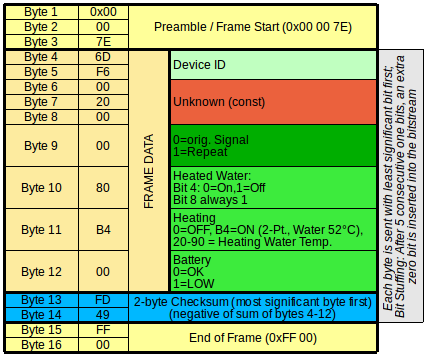

 .
.